Posts

downlaod

YouTube Video Downloader YouTube MP3/MP4 Downloader Download

Renu Spends 68% of her income. When her income increases by 40 and expenditure by 30%. Her saving is?

Image
In this post, we are going to solve a math question which is very important for CHSL, CGL, SSC GD, SBI PO, IBPS etc. Q. Renu Spends 68% of her income. When her income increases by 40 and expenditure by 30%. Her saving is? Sol.  Step-by-Step  Step1: Assume that Renu's original income = 100 Her original expenditure = 68 of 100 = 68 Her original saving = 100 - 68 = 32 Step2: After 40% increase in income New income = 140 Step3: After 30% increase expenditure New expenditure = 30 of 68 = 20.4 Step4: Calculate new saving: New saving = New income + New expenditure = 140-88.4 =51.6 Step5: Increase in savings: Increase in saving = New saving - original saving = 51.6 - 32 = 19.6 Step6: Percentage increase in saving: Percentage increase = Increase in saving/Original saving * 100 Percentage increase = 19.6/32 * 100 = 61.25 Therefore, the Renu saves 61.25%. Below is the Youtube video where you can easily unde...

Proof of Consistency Condition for Linear System

Proof of Consistency Condition for Linear System Proof of Consistency Condition for Linear System To prove that a necessary and sufficient condition for the system of linear equations \(AX = B\) to be consistent is that the matrices \(A\) and \([A \mid B]\) have the same rank, we will use the rank criterion for the consistency of linear systems. Necessary Condition First, we show that if the system \(AX = B\) is consistent, then \(\text{rank}(A) = \text{rank}([A \mid B])\). System is consistent: This means there exists a solution \(X\) such that \(AX = B\). Augmented Matrix Representation: The system \(AX = B\) can be written as an augmented matrix \([A \mid B]\). Implication for ranks: Since \(AX = B\) has a solution, the vector \(B\) lies in the column space of \(A\). Therefore, the addition of...

Intersection of Two Subspaces is a Subspace but no need of Union

Image
Intersection and Union of Subspaces Intersection of Two Subspaces is a Subspace Proof: Let \( S \) and \( T \) be two subspaces of a vector space \( V \) over a field \( F \). We shall prove that \( S \cap T \) is also a subspace of \( V \). Let \( \alpha, \beta \in F \) and \( x, y \in S \cap T \). Then \( x, y \in S \) and \( x, y \in T \). Since \( S \) and \( T \) are subspaces of \( V \), we have: \[ \alpha x + \beta y \in S \] \[ \alpha x + \beta y \in T \] Therefore, \[ \alpha x + \beta y \in S \cap T \] Thus, \( \alpha x + \beta y \in S \cap T \) for all \( \alpha, \beta \in F \) and \( x, y \in S \cap T \). Hence, \( S \cap T \) is a subspace of \( V \). Union of Two Subspaces Need Not Be a Subspace Now, by giving an example we shall prove that the union of two subspaces need not be a subspace. Example: Let \( V = \mathbb{R}^3 = \{(x, y, z) : x, y, z \in \mathbb{R}\} \) be a vector space over the field \( \mathbb{R} \) of all rea...

Liouville's Theorem in Complex Analysis

Image
Liouville's Theorem Art-15. Liouville's Theorem This theorem is very important, if you read this theorem carefully then some of the theorems coming up are based on this on which you can apply it and there are many questions where you can apply this theorem and you can solve those questions with Liouville's Theorem . Statement: If a function \( f(z) \) is analytic for all finite values of \( z \) and is bounded, then \( f(z) \) is constant. Proof: Let \( z_1, z_2 \) be any two points of the \( z \)-plane. Draw a circle \( C \) with center at the origin and radius \( R \), enclosing the points \( z_1 \) and \( z_2 \) so that: \( |z_1| < R \) and \( |z_2| < R \) Since \( f(z) \) is bounded, there exists \( M > 0 \) such that \( |f(z)| \leq M \) on \( C \). By Cauchy's integral formula, we have \( f(z_1) = \frac{1}{2\pi i} \int_C \frac{f(z)}{z - z_1} \, dz \) and \( f(...

Rule of Divisibility by 2,3 and 4 Hindi/English

It is very important to understand Rule of Divisibility because it is a way that a student can do faster calculations in their exam.  Divisibility rule are the shortcut way to determine that if a number is divisible by another number or not. It can enhance our calculation speed and accuracy and we can find the answer with in a second. Rule of Divisibility by 2: If the unit digit of a number is any 0,2,4,6 and 8 then that number will be completely divisible by 2.  Let's take a numbers:  98973232 8878438 893830 78733456 8768762494 Above, all the number are completely divisible by 2.  Let's take a number: 98973232 ÷ 2 = 49486616. Now, let's take a number where one's place have different number which is not divisible by 2.  For Example: 897987 ÷ 2 = 448993.5. Let's Understand from YouTube Rule of Divisibility by 3: If the sum of all the digits of the given number is completely divisible by...

Fundamental Theorem of Algebra in Complex Analysis

Image
  In this page, we are going to analysis the important topic or theorem in Complex Analysis.    Fundamental Theorem of Algebra in Complex Analysis is a very important topic to understand that can enhance your Higher Mathematics knowledge. Fundamental Theorem of Algebra in Complex Analysis Statement: If f(z) =  a 0 z n + a 1 z n-1 + ... + a n , a 0 ≠ 0 be a polynomial in z, then f(z) = 0 has at least one root in z-plane. Proof: If possible, let f(z) = 0 has no root in z-plane. Therefore, f(z)  ≠ 0 for any value of z in z-plane. We define, because, f(z) is analytic and f(z)  ≠ 0 therefore, F(z) is analytic for all values of z. Also, |F(z)| --> 0 as |z| -->  ∞  therefore, F(z) is bounded therefore, By Liouville's Theorem, F(z) is constant. ⇒ f(z) is constant, which is contradiction [because, f(z) is not constant polynomial] therefore, f(z) = 0 has at least one root in z-plane. Explanation in YouTube:

What is the unit digit in the number of (2137)753?

Image
Exam Questions What is the unit digit in the number of (2137) 753 ? a) 1 b) 2 c) 7 d) 9 Answer: To find the unit dight in the number(2137) 753 , we need to focus on the circle of unit digits in the number are raised to powers. Here, we have to focus on the when the power rised and which number is in the unit place. The unit digit of 2137 is 7. When the number 7 will rise the power as following patterns are repeats. 7 1 has a unit digit of 7 7 2 has a unit digit of 9 7 3 has a unit digit of 3 7 4 has a unit digit of 1 7 5 has a unit digit of 7 SInce, the pattern repeats every four powers, now we can find the reminder when 753 is divided by 4: 753/4 = 188 and with give a reminder of 1. This means that the unit digit of (2137) 753 will be same as unit dight of (2137) 1 ∴ the unit digit of (2137) 753 . That is option c is correct.

If the number 48327*8 is exactly divisible by 11, then the value of * is:

Quiz Quiz: Find the correct value of * If the number 48327*8 is exactly divisible by 11, then the value of * is: 2 3 9 1 Submit

Represent the complex number z = 1 + i√3 in the polar form.

Image
Complex Analysis Questions Complex Analysis Q. Represent the complex number z = 1 + i√3 in the polar form. Sol. 1 + i√3 = r(cos θ + isinθ) ∴ rcosθ = 1 ...(1) and rsinθ = √3 ...(2) Squring and adding (1) and (2), we get, r 2 (cos 2 θ + sin 2 θ) = 1 + 3 r 2 = 4 ⇒ r = 2 ∴ form (1) and (2), cosθ = 1/2, sinθ = √3/2 ∴ θ = Ï€/3 ∴ z = 1 + i√3 = 2(cos Ï€/3 + isin Ï€/3) The complex number z= 1 + √3 is represented by P(2,Ï€/3) into polar.

Triangle Inequality in Complex Analysis

Image
Triangle Inequality in Complex Analysis What is the Triangle Inequality? In Complex Analysis, it states that any two complex number z 1 and z 2 , the equality holds: |z 1 + z 2 | ≤ |z 1 | + |z 2 | Here, |z| denotes the modulus of the complex number, and the modulus of complex number z = x + y i , where x is the real number and y i is the imaginary number. So, in complex analysis is defined as, |z| = √(x 2 + y 2 ) What is the Triangle Inequality number theory? In Number Theory, the Triangle Inequality is discussed in the context of the absolute value function over the integers or the real number. It states that for any real number a and b, the Inequality holds: |a + b| ≤ |a| + |b| Proof of Triangle Inequality in Number Theory. Wha...

Triangle Inequality in Number Theory

Image
Triangle Inequality in Number Theory Triangle Inequality in Number Theory For any real numbers a and b , the Triangle Inequality states: |a + b| ≤ |a| + |b| Proof We will consider different cases based on the signs of a and b : Case 1: a ≥ 0 and b ≥ 0 |a + b| = a + b = |a| + |b| Case 2: a ≥ 0 and b < 0 (or vice versa) If a + b ≥ 0, then: |a + b| = a + b ≤ a - b = |a| + |b| If a + b < 0, then: |a + b| = -(a + b) = -a - b = |a| + |b| Case 3: a < 0 and b < 0 |a + b| = -(a + b) = -a - b = |a| + |b| Algebraic Proof Using the definition of absolute values: |a + b| 2 ≤ (|a| + |b|) 2 |a + b| 2 = (a + b) 2 = a 2 + 2ab + b 2 (|a| + |b|) 2 = |a| 2 + 2|a||b| + |b| 2 Since |a| 2 = a 2 and |b| 2 = b 2 : a 2 + 2ab + b 2 ≤ a 2 + 2|a||b| + b 2 ...

Number System(1)

Number System Number System We know that ten digits are used to write a number. There numbers are 0, 1, 2, 3, 4, 5, 6, 7, 8 and 9. To write a number, we take units like: tens, hundreds, thousand and etc. form right to left respectively. Example 1: Write the following numbers in words: 555555 Five hundred fifty-five thousand five hundred fifty-five. 978779 Nine hundred seventy-eight thousand seven hundred seventy-nine. 9787987 Nine million seven hundred eighty-seven thousand nine hundred eighty-seven. Example 2: Write the following numbers in words: ...

Cauchy-Riemann equations (or condition)

Cauchy-Riemann equations Proof of Cauchy-Riemann Equation

Euler's Theorem of Homogeneous Function

Euler's Theorem of Homogeneous Functions Euler's Theorem of Homogeneous Functions Euler's theory of equivalent functions clarifies a key concept in statistical analysis, showing the relationship between equivalent functions. Discover deeper insights into the scaling behavior of these functions and their impact on mathematical models, optimization, and applications. Unpack the basic principles of Euler's theorem and dive clearly and deeply into the fascinating world of identical functions. If \(z\) be a homogeneous function of \(x, y\) of order \(n\), then \(x\frac{\partial z}{\partial x}+y\frac{\partial z}{\partial y}=nz\) all Proof: Since \(z\) is a homogeneous function of \(x, y\) of order \(n\). \(z=x^{n}f(\frac{y}{x}) \dots (1)\) \(\frac{\partial z}{\partial x}=n~x^{n-1}f(\frac{y}{x})+x^{n}.f^{\prime}(\frac{y}{x}).(-\frac{y}{x^{2}}).\) or ...

Charpit’s Method or General Method to Solve Non-Linear Partial Differential Equation

Image
Charpit’s Method Charpit’s Method or General Method to Solve Non-Linear Partial Differential Equation Charpit’s Method: It is a well-known mathematical technique known as “Method of Characteristics”. The method is widely used for solving first-order or quasi-linear PDE’s. Explanation of Method: Let the given differential equation be: Different Types of Solutions in PDE \[ f(x, y, z, p, q) = 0 \quad \text{(i)} \quad \text{where} \quad z = z(x, y) \] We know \( dz = \frac{\partial z}{\partial x}dx + \frac{\partial z}{\partial y}dy \). [Therefore, z=z(x,y)] \( dz = p \, dx + q \, dy \quad \text{(ii)} \). Now we shall find another relation \( F(x, y, z, p, q) = 0 \quad \text{(iii)} \) so that on solving equations (i) and (iii) for \( p \) and \( q \) and putting these values in (ii), equation (ii) becomes integrable, and this integral gives the complete solution of (i) (integral). For finding \( F \), differentiate (i) with resp...

Types of Solutions in Partial Differential Equation | Study With Nitin

Image
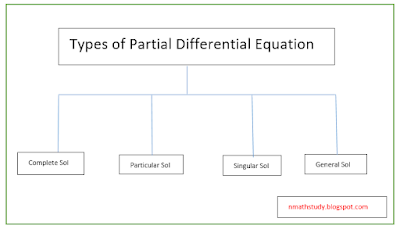
In Partial Differential Equation questions are solving to some important forms Lagrange's Linear Equation, Charpit's Method and etc. Here the concept of solutions are very vital to understand for solving the P.D Equation. Types of Solutions There are four types of solutions are listed below - Complete Solution Particular Solution Singular Solution General Solution Complete Solution When a partial differential equation f(x,y,z,p,q) = 0      ...(i) where, z is the function of independent variables x and  y and f   be the function of dependent variables. Here we obtain a relation g(x,t,z,a,b) = 0 there are many arbitary constants as a number of independent variables, then g(x,y,z,p,q) = 0 is called the complete solution or integral of eq( i ) for example, z = ax + by +f(a,b) is the complete solution of z = px +qy +f(p,q) Particular Solution First of all we have a differential equatio...

Show that the following pair of functions are linearly independent yet Wronskian vanishes on the given interval

Linear Independence and Wronskian Show that the following pair of functions are linearly independent yet their Wronskian vanishes on the given interval $$f_{1}=\begin{cases}x^{2},x\ge0\\ 0,x Sol. The given functions are $$f_{1}=\begin{cases}x^{2},x\ge0\\ 0,x We want to prove that $$f_{1}$$, $$f_{2}$$ are L.I. For this purpose, we shall show that ...(1) if $$c_{1}f_{1}+c_{2}f_{2}=0$$ for all $$x\in\mathbb{R}$$, then each of $$c_{1}$$, $$c_{2}$$ is zero. For this purpose, we use $$x=-1.1$$. Now $$f_{1}(1)=1$$, $$f_{2}(1)=0$$, and $$f_{1}(-1)=0$$, $$f_{2}(-1)=1$$. Substituting these values in (1), we get, $$c_{1}\cdot1+c_{2}\cdot0=0\Rightarrow c_{1}=0$$ and $$c_{1}\cdot0+c_{2}\cdot1=0\Rightarrow c_{2}\rightarrow0$$ We have $$c_{1}f_{1}+c_{2}f_{2}=0\Rightarrow c_{1\frac{3}{3}}=c_{2}=0$$ Hence $$f_{1}$$, $$f_{2}$$ are linearly independent on the given interval. Now, we find the Wronskian of the given functions. Two cases arise. Case I. When $$x\...

Show by Wronskian that x, x^3, x^4 are Linearly Independent if x is non-zero.

Image
  Let          f1(x) = x,     f2(x) = x^3,     f3(x) = x^4                  f'1(x) = 1,    f'2(x) = 3x^2  f'(x) = 4x^3                  f"1(x) = 0,   f"2(x) = 6x,    f"3(x) = 12x^2 W( f 1, f 2, f 3) =                     =  Taking x common form 1st Row                =                =  Now,                                         = x(24x^4 - 18x^4)                                        = 6x^5 which is not equal to o Therefore...

Prove that if the Wronskian of the functions are Linearly Independent over I

Image
Th. Prove that if the Wronskian of the functions \(f_{1}\, f_{2}\, \ldots f_{n}\) over an Interval I is non-zero, then the functions are linearly independent over I. Proof Proof: Consider the relation \[ c_{1}f_{1} + c_{2}f_{2} + \ldots + c_{n}f_{n} = 0 ...(1)\] where \( z_{1}, c_{2}, \ldots, c_{n} \) are constants. Differentiating (1) successively \( n-1 \) times with respect to \( x \), we get, \[ c_{1}f'_{1} +c_{2}f'_{2} +c_{3}f'_{3} + \ldots + c_{n} {f_{n}}^{\prime} = 0 ...(2)\] \[ c_{1}f''_{1} + c_{2}f''_{2} + \ldots + c_{n}f''_n = 0 ...(3)\] \[ c_{1}{f_{1}}^{(n-1)} + c_{2}{f_{2}}^{(n-1)} + \ldots + c_{n}{f_{n}}^{(n-1)} = 0 ...(n)\] Here The Vidoe in Youtube These \( n \) equations can be written as \[ \begin{bmatrix} f_{1} & f_{2} & \ldots & f_{n} \\ f'_{1} & f'_{2} & \ldots & f'_{n} \\ f"_{1} & f"_...